C-SNP vs. D-SNP: What's the Difference in Medicare?
Medicare has several types of Medicare Advantage plans.
Some are designed specifically for beneficiaries with particular healthcare or eligibility needs.
These are called:
Special Needs Plans
or
SNPs.
Two types you may hear about frequently are:
C-SNP
and
D-SNP
The names sound similar.
But the reason someone qualifies is different.
What Is a Medicare Special Needs Plan?
CMS defines a Special Needs Plan as a Medicare Advantage coordinated care plan designed for specific populations.
There are three main categories:
C-SNP
Chronic Condition Special Needs Plan
D-SNP
Dual Eligible Special Needs Plan
I-SNP
Institutional Special Needs Plan
This article focuses on the first two. To join an SNP, you must have Medicare Part A and Part B, live in its service area, and meet its specific eligibility requirements.
What Is a C-SNP?
C-SNP stands for:
Chronic Condition Special Needs Plan
These plans restrict enrollment to people who meet the plan's qualifying criteria for certain severe or disabling chronic conditions.
CMS lists broad categories of severe or disabling chronic conditions for C-SNP purposes. The exact qualifying diagnoses and approved groupings depend on the plan.
These include:
Chronic alcohol or other drug dependence.
Certain autoimmune disorders.
Cancer.
Certain cardiovascular disorders.
Chronic heart failure.
Dementia.
Diabetes mellitus.
End-stage liver disease.
End-stage renal disease requiring dialysis.
Certain severe hematologic disorders.
HIV/AIDS.
Certain chronic lung disorders.
Certain chronic and disabling mental health conditions.
Certain neurologic disorders.
Stroke.
The exact conditions served depend on the individual C-SNP.
Having a Chronic Condition Does Not Automatically Qualify You for Every C-SNP
This point matters.
Someone may have a chronic medical condition but not qualify for a particular C-SNP.
The plan must be designed for that qualifying condition or approved grouping.
Eligibility generally has to be verified according to Medicare and plan requirements.
What Is a D-SNP?
D-SNP means:
Dual Eligible Special Needs Plan
A D-SNP serves people who have:
Medicare
and
Medicaid eligibility or qualifying Medicaid assistance
These beneficiaries are commonly called:
Dual eligible beneficiaries
D-SNPs can help coordinate benefits between Medicare and Medicaid.
Does Everyone With Medicaid Qualify for Every D-SNP?
No.
Medicaid eligibility can exist at different levels.
CMS identifies categories that include:
Full Medicaid.
QMB Only.
QMB Plus.
SLMB Only.
SLMB Plus.
QI.
QDWI.
Plan eligibility may depend on the Medicaid category accepted by the particular D-SNP.
State Medicaid rules can also differ.
That is why eligibility should be verified before assuming someone can join a particular D-SNP.
The Simple Difference
The easiest way to remember it:
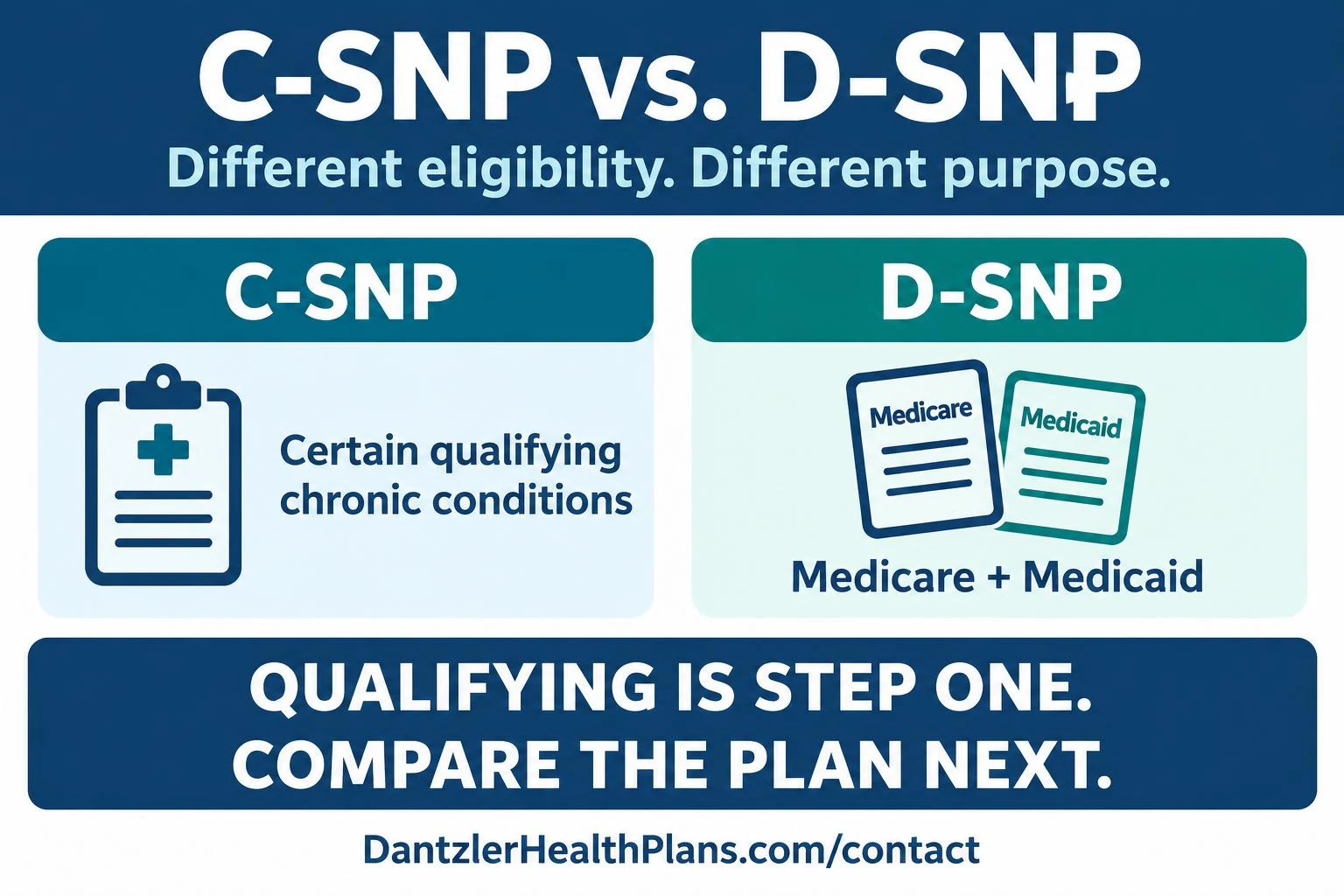
C-SNP
Eligibility is primarily connected to a qualifying:
Chronic medical condition
D-SNP
Eligibility is primarily connected to having:
Medicare + Medicaid
Think:
C = Condition
D = Dual
Could Someone Potentially Qualify for Both Categories?
A person can potentially have characteristics associated with both categories.
For example:
Someone may have diabetes and also receive Medicare and Medicaid.
That does not mean every C-SNP or D-SNP is available to that person.
Plan eligibility, service area, Medicaid status, and other rules still apply.
The question becomes:
Which available plan is the appropriate fit for the beneficiary's situation?
What Do C-SNPs and D-SNPs Have in Common?
Both are Medicare Advantage Special Needs Plans.
Both cover the Medicare Part A and Part B services required of Medicare Advantage plans.
All SNPs must also include:
Medicare Part D prescription drug coverage
CMS also requires SNPs to provide care coordination.
Medicare says these plans tailor benefits, provider choices, and drug formularies toward the specific populations they serve.
What Is Care Coordination?
Someone with complex healthcare needs may work with:
Primary care.
Specialists.
Hospitals.
Pharmacies.
Other providers.
A Special Needs Plan is designed to coordinate care for the population it serves.
That does not mean every service is automatically covered or every provider participates.
Plan rules still matter.
Doctors and Hospitals Still Matter
Do not select an SNP based only on eligibility.
Check:
Primary care doctor.
Specialists.
Hospital.
Dialysis facility if applicable.
Other important providers.
Some SNPs operate as HMOs.
Others may operate as PPOs.
Network rules can therefore vary.
Prescription Coverage Still Matters
All SNPs include Part D.
But that does not mean every medication is covered the same way.
Review:
Formulary.
Drug tier.
Prior authorization.
Step therapy.
Quantity limits.
Preferred pharmacy.
Prescription costs.
Medicaid Coordination in a D-SNP
D-SNPs can help coordinate Medicare and Medicaid benefits.
But the amount Medicaid pays depends on the person's Medicaid eligibility category and applicable state rules.
Do not assume every D-SNP member has zero out-of-pocket costs.
CMS recognizes D-SNPs with both zero-dollar and non-zero Medicare cost-sharing structures.
Review the beneficiary's actual Medicaid status and the specific plan.
Can You Stay in an SNP Forever?
Not automatically.
Medicare explains that beneficiaries can remain enrolled in an SNP only while continuing to meet the plan's qualifying conditions.
If you no longer meet the qualifying conditions, you may need different coverage. Enrollment options and timing depend on your circumstances. Verify the next steps with your plan or Medicare before making a change.
Questions to Ask Before Joining a C-SNP
Ask:
What condition qualifies me?
How will the plan verify the diagnosis?
Are my doctors in network?
Are my prescriptions covered?
What care management services are available?
What prior authorization requirements apply?
What are my expected costs?
Questions to Ask Before Joining a D-SNP
Ask:
What level of Medicaid eligibility do I have?
Does this plan accept my Medicaid category?
How are my Medicare and Medicaid benefits coordinated?
Are my doctors in network?
Are my medications covered?
What costs could I still have?
What supplemental benefits are included?
C-SNP vs. D-SNP Quick Comparison
C-SNP
Eligibility basis: Qualifying chronic condition
Purpose: Coordinate care around specific chronic healthcare needs
Medicaid required: No
D-SNP
Eligibility basis: Medicare plus qualifying Medicaid eligibility
Purpose: Coordinate Medicare and Medicaid benefits and healthcare needs
Chronic condition required: Not necessarily
Both
Medicare Advantage.
Part D included.
Care coordination.
Plan-specific provider networks and benefits.
Qualifying Is Only Step One
This may be the most important lesson.
Hearing:
“You qualify for a Special Needs Plan.”
does not mean:
“This is automatically the best plan for you.”
Eligibility tells us which doors may be open.
The next step is comparing what's behind those doors.
Review:
Doctors.
Hospitals.
Medications.
Pharmacy.
Costs.
Benefits.
Prior authorization.
Care coordination.
Then make the decision.
Get Help Reviewing Your Medicare Options
If you are reviewing C-SNP or D-SNP options, Dantzler Health Solutions can help explain plans we represent in your service area.
Start here:
Contact Dantzler Health Solutions
Completing the form does not automatically enroll you into a Medicare plan.
It gives us a starting point for understanding your coverage needs and eligibility.
C-SNP = qualifying chronic condition.
D-SNP = Medicare + Medicaid.
Education first.
I'm La Jon Dantzler, founder of Dantzler Health Solutions.
Think You May Qualify for a Special Needs Plan?
Let's start with your eligibility, doctors, medications, and healthcare needs.
Related Medicare education
Official sources
Educational eligibility note
This content is provided for educational purposes. C-SNP and D-SNP eligibility depends on Medicare requirements, plan-specific criteria, service area, qualifying chronic conditions, Medicaid status, and other applicable rules. Plan availability, provider networks, formularies, benefits, premiums, and cost sharing vary.
Still have questions?
Book a free, no-pressure review and we'll walk through your options together.
Book a Free ReviewRelated articles
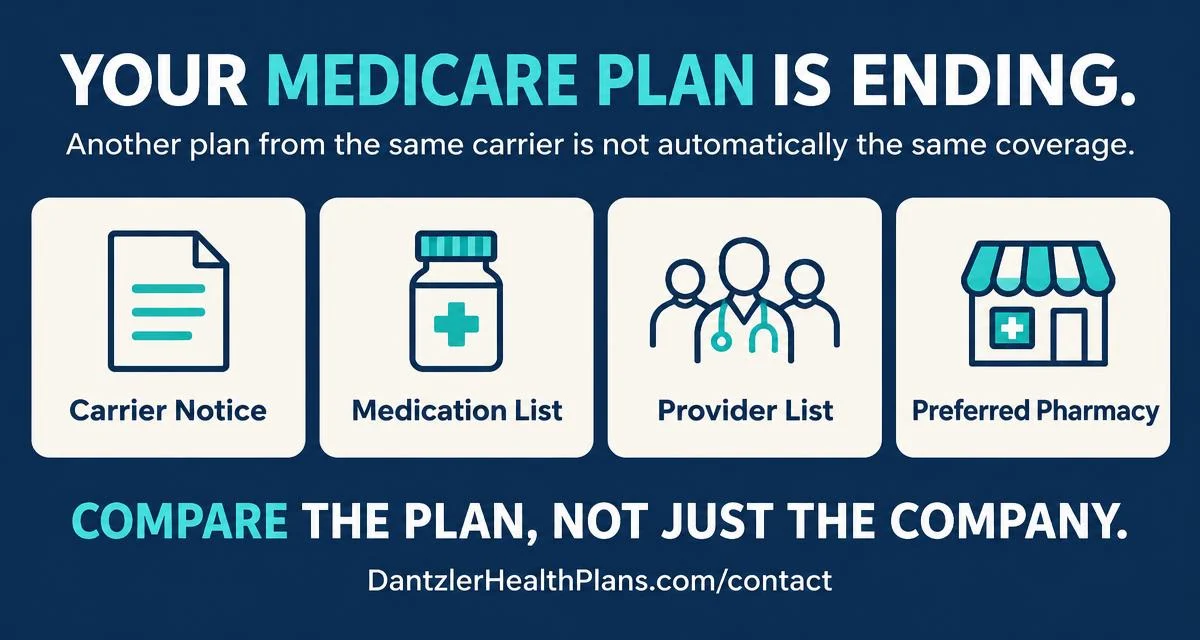
Your Medicare Advantage Plan Is Ending for 2027: What Should You Do Next?
If your Medicare Advantage plan is ending for 2027, bring your carrier notice, medication list, provider list, and preferred pharmacy before choosing replacement coverage.
Read: Your Medicare Advantage Plan Is Ending for 2027: What Should You Do Next?
Medicare Crosswalk Explained: How to Read Your Plan's Change Letter
Each fall, your Medicare plan sends a letter about next year's changes. Here is how to read it, what to compare, and when to act.
Read: Medicare Crosswalk Explained: How to Read Your Plan's Change Letter